
 Donate
Gifts from the Desert: The Ledbetters’ Journey
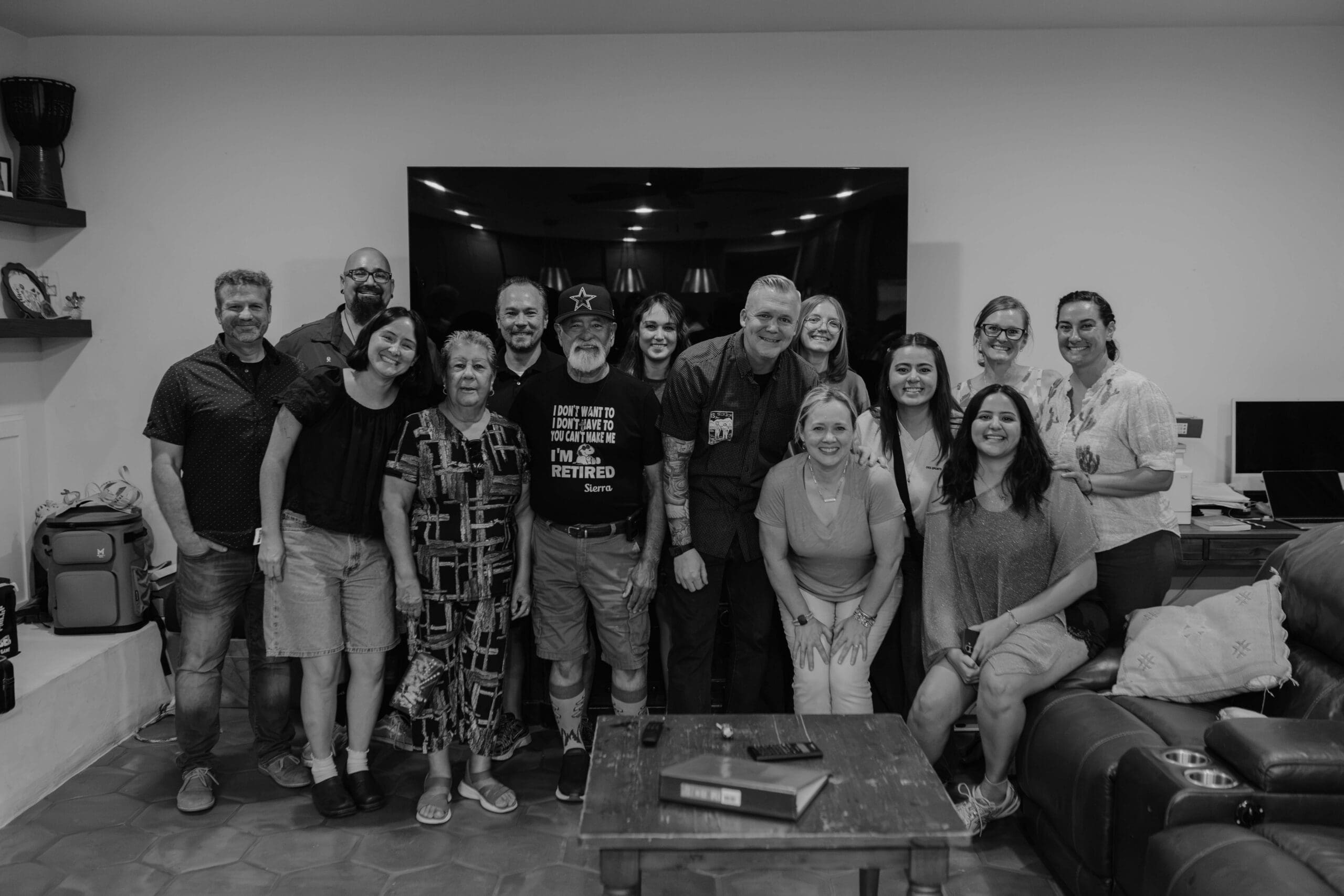
Why are we called into the desert? What is there to be learned from life on the edge of an empire?
After more than five years of faithful vocation at Abara, our teammate Nate Ledbetter and his family will be moving on to a new chapter in the community of Pine Bluff, Arkansas. We will deeply miss them, and we are deeply grateful. Nate has been integral to laying the foundation for Abara since the summer of ‘21.
Clara sat down to interview Nate during his last week with Abara.
We wanted to find out: What has El Paso/Juárez meant to you and your family? Why do you believe God led you here, and what did you find? Read Nate’s answers below.
1. What were some of your first impressions of the borderlands?
“I remember the beauty, the people, the heart of the people, the graciousness of people. My first visit was in 2019, in the wake of the mass shooting on August 3rd. There were still a lot of memorials…the tragedy was fresh in the consciousness of the city. Even so, I remember feeling the joy of God’s movement in the world. The physical environment is striking, and underneath, I felt a sense of God’s movement, the wind of the Spirit blowing freely, long before we arrived.”
2. What was drawing your family here? How would you have described it to me on your trek across the country from Charlotte?
“We try to only go where we are invited, and where there is community confirmation. I remember being drawn to Abara for this sense of bridge building, and the idea of borders in all their different shapes, sizes, forms. Of course, we felt the anticipation of joining a beautiful, binational community. In other places we’ve lived, we’ve continually felt drawn to acting as bridges between spaces and people who are unlike each other– and, realizing how much we are alike, and how much ground we do share. This kind of work, near a dividing line, has been an invitation in both Melissa’s and my own life since we were really young.”
3. What were some of the challenges, and the delights, of settling into life in El Paso?
“We attempted to come as listeners, as learners, as students. I tell my kids, ‘It’s more than okay, it’s a beautiful thing to be a learner’. In those early days, I realized that I was being invited to a childlike faith. I had to embrace my limitations as a gift. I learned that It takes a while to really listen up close. The heart of this place is so big and wide and deep – it’s able to hold so many people in one in between, liminal space. Hospitality has been baked into the DNA of the borderlands for generations.”
4. What was it like for you to be surrounded by Spanish?
“I’ve struggled with language learning my whole life. And also, I’m a communicator, and highly relational, whether public speaking or connecting with people one-on-one as a neighbor or friend. It’s a part of the way I’m designed. On the streets of El Paso and Ciudad Juárez, I regularly felt my own language limitation, the struggle to be able to fully hear and understand someone, and to be understood. I would ask God, “Give me imagination. Help me to see and hear differently. Help me to be open to new ways of connecting and communicating. How can we together hold my own limitations and listen deeper?”
“It’s amazing how much longer a conversation or meeting can take because of the need for interpretation. This is actually a gift–slowing down, to see people and to hear people. There’s something that happens in the middle of all that which takes friendship deeper.”
5. As visitors often came through Abara, what did you find yourself repeating to them, at the simplest level, about what you saw in the Borderlands?
“Being part of a binational community is a JOY! The border isn’t what we’ve been told. So many are drawn to see the fence, the physical barriers that exist here. It’s grabbed the attention of the national consciousness. But there are so many invisible borders, borders that exist in all of our communities.”
6. What are some of the touchstones of your time here, lessons that most impacted you and your family?
“I actually keep a pile of rocks and broken glass on my dresser at home. We collected them on this ancient land (the Abara campus) as a reminder that wholeness is possible for our own lives and at a community level. We are called to actually respond to the cries that we are hearing. We are meant to respond. God’s heart for all people, everywhere, continues forward. I believe that will never change. It’s up to us to catch up to God’s vision and dream for Beloved Community…God’s vision for the broken pieces to be made whole again. To remember that it’s still possible, and to get up every day and give our lives toward that end. This includes my own brokenness, my own life–I’m not apart from that. It’s not only looking outward. Even in the middle of suffering, brokenness, trauma, pain, the broken pieces can be put back together again.”
7. Can you articulate today why you think you were called into the desert in 2021?
“The short answer is I have no idea. I still sometimes have no idea. Other times, it makes all the sense in the world. So much of the desert is a mystery. It’s a thin space. The desert invites us to…an active place, but also a place of stillness and slowing down. I read the ancient scriptures differently because of our short time here—the scriptures that speak of the physical desert, of desert seasons. I will hold onto that forever.”
“Also, life in El Paso has made all the sense in the world in my own healing journey. God invited me here to deepen my compassion and my empathy alongside curious souls who come and go. I can’t express enough how grateful I am to have been part of Team Abara. My words feel too small… My love for faith communities and the big C church has been renewed in this space. My own connection with the Divine has deepened in this space. And so has that of my family. My love for neighbor has grown across spaces, cultures, and understandings in ways I could never have imagined.”
“These things have been renewed in us, as gifts, from the desert.”
Written by Clara D. Compean and Nate D. Ledbetter, August 2026