
 Donate
Pulled by the South
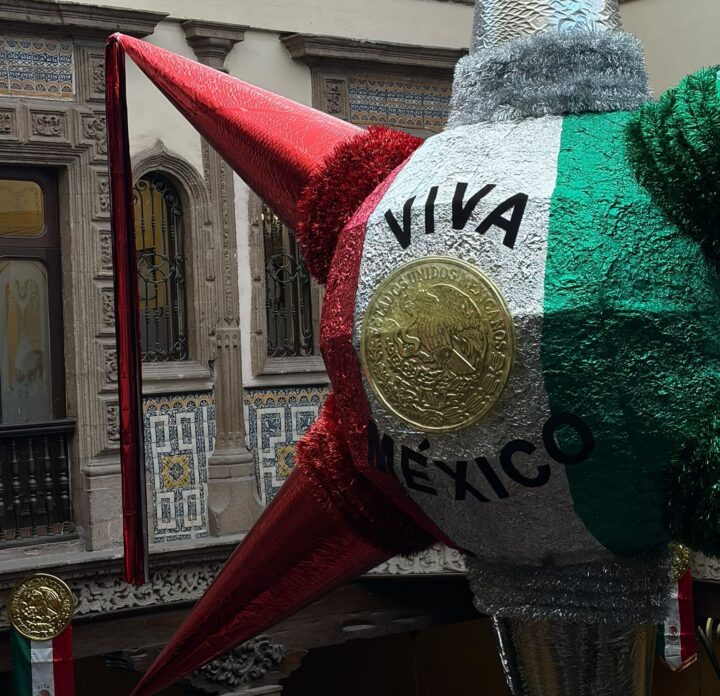
I identify as a “fronteriza”, or a borderlander, which means that I grew up in two worlds, two cultures. I grew up in a unique space (physically and emotionally) that can be hard for outsiders to understand.,The borderlands are a “third space” with distinct dynamics and feelings.
To live on the US-México border is an “espada de doble filo” (double edged sword). There is a part of the population (in all Mexican border cities) where the notion of the “American dream” —the U.S. being only a few kilometers away— is ingrained in our brains since we were kids. My friends and I were led to believe that the only good jobs in Juarez were those inside the factories or the “maquiladoras”. Thus, if you want to stay in Juárez, you’d better study Engineering. It almost felt that in terms of employment, we were only allowed to dream beyond the maquila industry if we went to study and work in the U.S.
As a young person in the Mexican border region, you get used to the idea of wanting more, and that “more” means to go and work/live in the U.S. You are constantly being pulled by the force of the north, the force of the United States.
This makes sense if we put it into a political & historical perspective. We live on an asymmetrical border. The asymmetry of power between the U.S. and Mexico is very clear; the force of the north is stronger. For those that live on the Mexican side, this can be both exhausting and draining. You are constantly comparing your life with those who are living in the U.S. Why? Because of proximity! Even if you do not want to think about it, our lives at the border are interconnected. For instance, my oldest sister lives in El Paso while I live in Juarez. Even though we went to the same schools growing up and went to the same college, her life is different from mine.
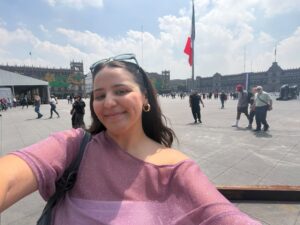
However, now that I’m almost 29 years old, I ask myself, “what if it was always supposed to be the other way around? To be pulled by the south, by/to my Mexican roots?” I just came back from a trip to Mexico City, and this is a question that has been on my mind since that trip. It can be refreshing to see so many people wanting to visit your country, to know your culture, or even to just see other Mexicans living their normal lives as if they have never thought about having to leave the country to do that. In Juarez you do not see that type of scenery/energy since it is not a touristic site (we are more used to academic tourism for those that want to understand the violence dynamics or the border dynamics). It has taken me almost five years to deconstruct this idea of having to go the north to feel accomplished.
This September (Mexican Independence Day is the 16th and we celebrate all month!), I think about my Mexican identity, and I feel very proud to be part of this country and to be able to share all its beauty to those who are eager to learn from our culture and history. Mexico has so much to offer to the world and I truly hope that all my fellow fronterizos start this deconstruction to ease our hearts and honor our roots. It is possible to be fronteriza/o without having to give up the Mexican part of our identity. Viva Mexico!
Written by Victoria de Anda