The Story of Annunciation House

ab687c90-3463-40c0-49e9-857c4681d434

At Abara, we dream of a world without “others,” where fear gives way to connection, and every person’s humanity is fully honored. This year and last year you might have heard about the litigation between Texas and Annunciation House.

First, let’s back track. Throughout the year 2024, the Texas Attorney General, Ken Paxton, used his office at least five times to probe groups that work with immigrants. All of these cases ended in the nonprofits’ favor, or were dropped by the AG’s office, except for a case against a historical El Paso migrant shelter called Annunciation House.

Here in El Paso, Annunciation House has been a cornerstone of the immigration nonprofit community for nearly 50 years. The organization primarily serves migrants who have been processed and released into the U.S. by federal immigration authorities on their own recognizance.

If you follow the trail all the way back to December 2022, Texas Governor Greg Abbott requested an investigation into NGOs he alleged were facilitating illegal border crossings, particularly those operating in El Paso.

photo of Annunciation House by the Dallas Morning News

During the Biden administration, there was a broader effort by Texas state officials to establish the state as a new frontier for immigration enforcement.

In Paxton’s words, “the federal government perpetuates the lawlessness destroying this country,” while his Texas office works “day in and day out to hold these organizations responsible for worsening illegal immigration.” Texas has moved to challenge the federal government’s long-standing authority over immigration, aiming to seize power through policies like Operation Lone Star and TX SB-4. In truth, starting in 2005, Texas has launched increasingly aggressive border security operations.

We feel that laws like these empower local law enforcement to criminalize migrants, and represent a major challenge to the traditional federal role in immigration enforcement.

Initiatives like Operation Lone Star and the lawsuit against Annunciation House are grounded in the belief that border states like Texas must act to address a border crisis. For these policies to gain support, they must function without context or human connection, allowing fear to easily take root. Ultimately we risk losing sight of the human beings behind the headlines—and, ultimately, our shared humanity.

photo by Wright & Dalbin Architects

This is the Annunciation House story: On February 7, 2024, Paxton’s office sent three lawyers to request client records from the shelter, citing the Texas Business Organizations Code. They requested logs identifying individuals who had been sheltered going back more than two years, giving Annunciation House just 24 hours to comply. When Annunciation House sought more time and requested a judge’s decision on which records could legally be released, Paxton’s office interpreted the delay as noncompliance and filed a countersuit to shut down the shelter on February 16th, 2024.

On March 11th, 2024, Judge Dominguez blocked the investigation, ruling that Paxton’s office must go through the state court system, not consumer protection laws. He expressed concerns over possible political motives behind the investigation and emphasized that Annunciation House showed willingness to comply, while Paxton’s office made no effort to negotiate.

In a second ruling on July 2, 2024, Dominguez rejected Paxton’s attempt to shut down Annunciation House, calling the state’s request “unconstitutionally vague.” He stated the investigation appeared to be a pretext to justify harassment of shelter staff and refugees.

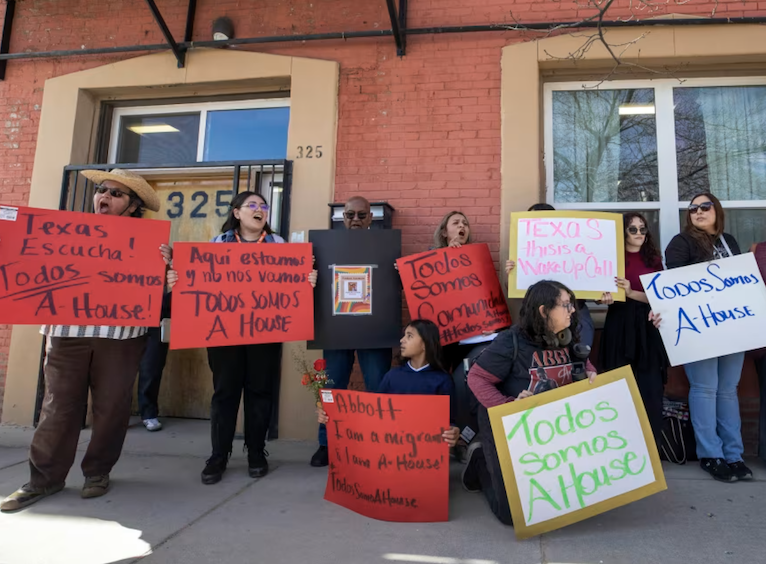
“We are all A House.” Photo by CNN

Judge Dominguez expressed concerns that the Attorney General did not specify which laws were being violated from the outset, and the record before the Court established the Attorney General had been seeking evidence of alleged criminal activity all along. Dominguez called Paxton’s actions “outrageous and intolerable,” and concluded that the investigation burdened the nonprofit’s right to free exercise of religion. On July 16th, 2024  Paxton appealed the Dominguez ruling to the Texas Supreme Court.

Just last month, almost one year later,  the case was heard in the Texas Supreme Court and the court ruled in favor of Paxton 8-0. The court emphasized that it was not ruling on the merits of the case itself, but rather on the Attorney General’s ability to initiate legal proceedings like a quo warranto action (a legal challenge to a corporation’s right to exist). The case was then “remanded,” or sent back to the lower court for further proceedings, where the Attorney General’s claims against Annunciation House will be further examined.

So, why does this matter? Paxton has a long history of targeting organizations whose work conflicts with his political views or those of his conservative base. It is essential we recognize the dangers here, especially regarding Paxton’s abuse of power and authority, ultimately threatening the ability of nonprofits to provide humanitarian aid. Abara is grateful to work alongside our friends at Annunciation House House toward a humane, dignified treatment of those passing through our borderlands.

This shelter network runs 100% on volunteers from around the country. If you would like to give of your time at Annunciation House, visit https://annunciationhouse.org/get-involved/.

Story written and researched by Anamaria Solis, Loretto Justice Fellow