
 Donate
Abara Featured in a Carnegie Corporation of New York Article

Abara, a nonprofit in El Paso, Texas, guides participants on a three-day program to better understand issues around immigration, including a hike up Mount Cristo Rey where they can view the U.S.-Mexico border. (Credit: Sue Dorfman)
When viewed from above, the border cities of El Paso, Texas, and Ciudad Juárez, Mexico, appear to merge into a continuous area. Residents of these cities traveled back and forth with few restrictions until 1929, when the United States passed a law prohibiting unauthorized border crossings.
Today, El Paso has become a focal point of the national debate over immigration. It was here that the Trump administration piloted its “zero tolerance” immigration policy in 2017, which prosecuted any adults who crossed the border illegally, with no exceptions for asylum seekers. The city currently hosts some of the country’s largest detention centers for migrants, as part of the Trump administration’s mass deportation strategy. In August 2019, a mass shooter killed 23 people in an El Paso Walmart, writing in a manifesto that he wanted to target Hispanic immigrants. It was the deadliest attack on Latinos in modern U.S. history.
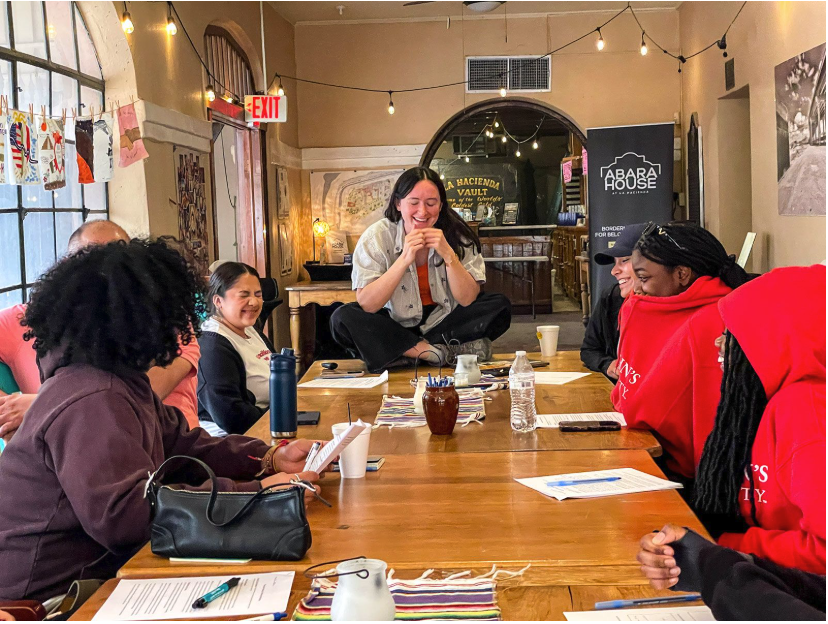
Abara program facilitator Clara Duffy (on table) leads a discussion with participants in the Abara Border Encounters program, asking them to reflect on what they learned during the guided trip through the El Paso borderlands region. (Credit: Sue Dorfman)
Abara is a nonprofit founded in El Paso in February 2019 to reduce polarization around immigration. “Abara starts with this idea that fear over immigration is dividing us,” says Nate Ledbetter, the organization’s director of partnerships and engagement. “Our response is to create spaces for connection and belonging to build peace.” Its signature initiative is a three-day program called Border Encounters, a guided trip that aims to humanize the people of the border region by arranging for visitors to have face-to-face conversations with everyone from migrant shelter residents to U.S. border agents and local immigration advocates.
In 2024, the nonprofit hosted 321 Border Encounters participants from 25 states, including students, teachers, and faith leaders. “It’s about inviting people to come and listen to the border,” says Ledbetter, “and to hear and see one another, especially across dividing lines.”
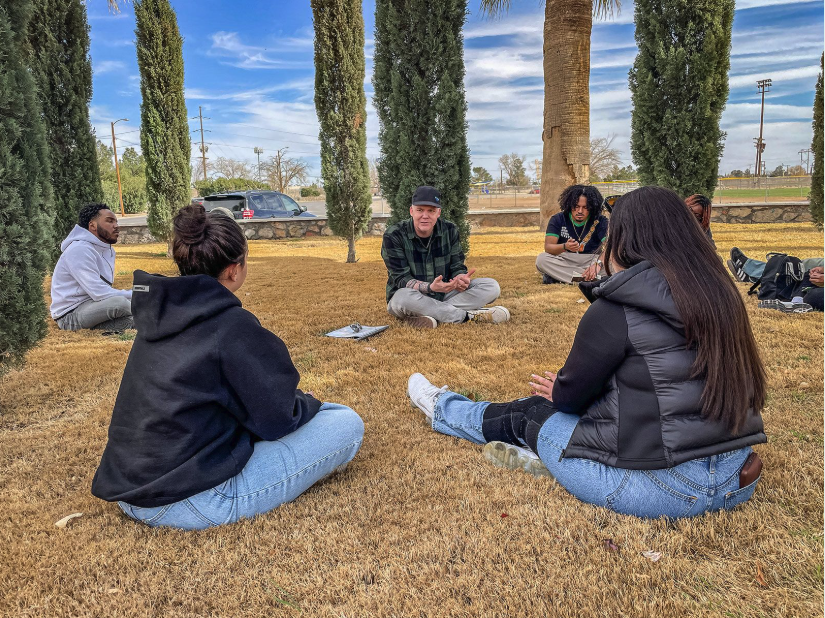
Abara staffer Nate Ledbetter (center) leads a discussion with St. John’s University students at the memorial for victims of the 2019 El Paso Walmart mass shooting. In a manifesto, the shooter wrote that he wanted to target Hispanic immigrants. This location is one stop on Abara’s Border Encounters program, a guided three-day trip through the border region that aims to decrease division around immigration. (Credit: Sue Dorfman)
Nate Ledbetter
Director of Partnerships & Engagement, Abara
We believe the border has something to teach the country. Our Center for Peace and Transformation is in El Paso, right up against the fence — just a few feet from Mexico. It’s where we host what we call Border Encounters: three-day trips through the border region, created in partnership with local leaders, that let people see things firsthand.
We’ve had everyone from college students to faith leaders to policymakers. Some come in thinking they already understand the border. Then they experience our site visits. And something shifts.
These encounters are not “tours” or acts of charity. We enter as guests — not saviors — listening to asylum seekers, shelter partners, and community leaders. By invitation, we sit in circles, meet former Border Patrol agents, reflect at memorials, and pause to hear the desert itself. One person said to us, “The experience humanized migrants on a level I did not anticipate.”
Nothing at Abara is dreamed up in a back office. Our campus, partnerships, and practices are shaped through listening with our community in Juárez-El Paso, one of the kindest, most hospitable communities I’ve ever known. In today’s polarized climate, we invite people from across the nation to come, let their guard down, and listen to what the border has to say.
Read the full article here.